
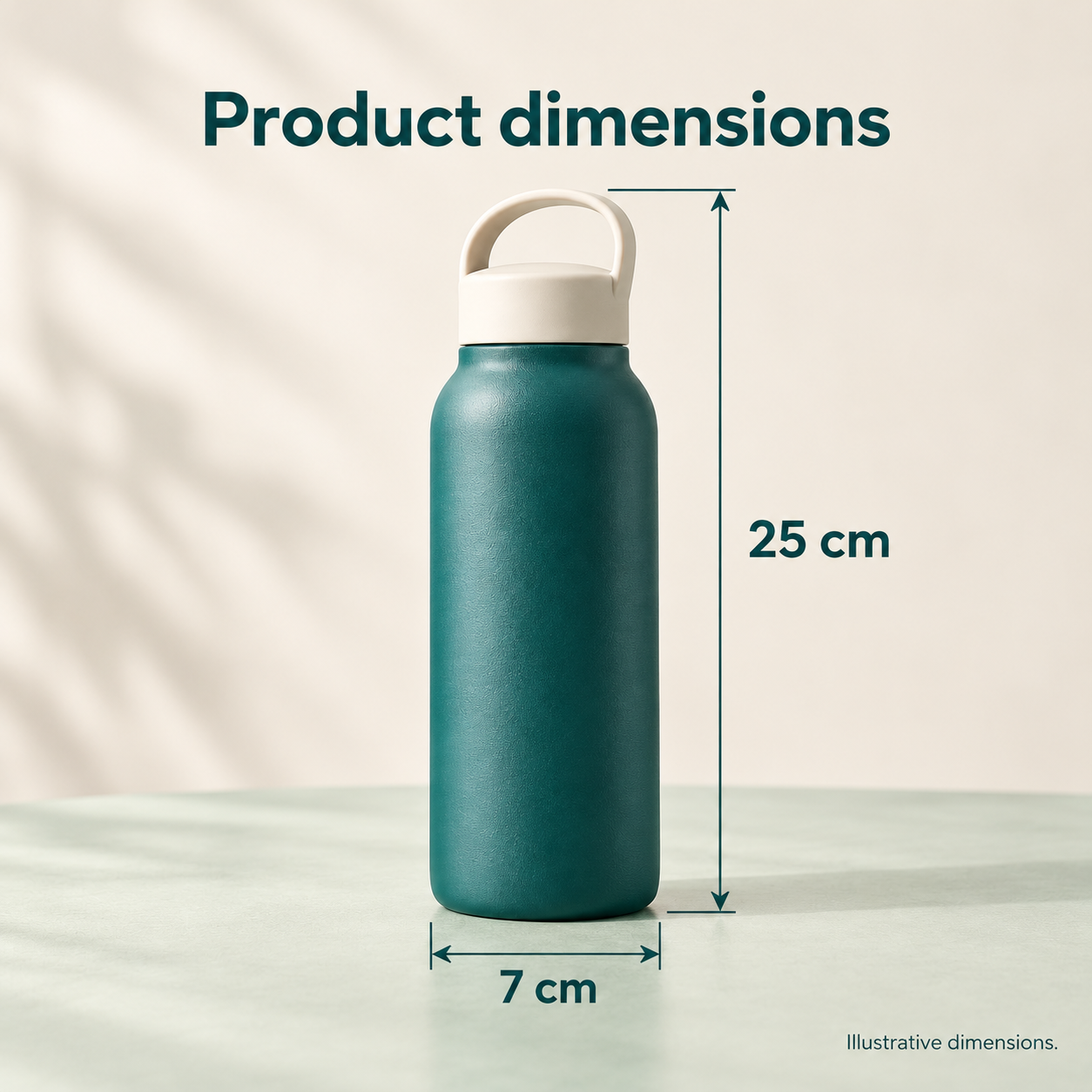
A correctly shaped product can still look wrong when its scale is implausible. A bottle taller than a laptop or a tiny lunch box in someone's hands gives the wrong visual information. A useful size brief combines the item's dimensions, nearby objects and believable perspective.
Supply measurements with clear units
When available, provide height, width, depth, diameter and capacity with explicit units. State the orientation so height is not mistaken for width. For sets, explain whether measurements refer to one item, its package or the assembled product.
Do not invent numbers to fill a field. If a dimension is unverified, leave it out or obtain the correct information before generating. Capacity and exterior size are different facts: a volume in milliliters does not determine a product's height on its own.
Separate physical scale from framing
A product may fill most of an image because the camera is close without being large in real life. Asking it to occupy half the frame therefore does not solve its size relative to a hand, desk or computer. Framing controls composition; dimensions and spatial relationships guide physical scale.
In scenes with people, describe the grip and the action. Check finger contact, handle size and the relationship between the wrist and product body. Familiar objects can help in scenes without people, but those objects also need plausible dimensions.
Use dimension lines to explain the geometry
A label reading 25 cm cannot fix a visually disproportionate object. Review the geometry first. Then place dimension lines outside the silhouette with clear endpoints and readable units. Avoid arrows crossing important details or pointing to the wrong component.
When showing variants, maintain consistent relative scale. Do not depict different sizes at the same visual height if the purpose is to explain their difference. Mixed viewpoints can make a comparison confusing; a simpler layout may communicate more clearly.
Check the result before publication
Review every number and compare relationships with the reference. AI image tools may ignore exact values. Clear instructions improve direction but do not guarantee technical measurement accuracy. When dimensional precision is essential, consider controlled photography or a technical representation based on manufacturer data.
In MyListing, dimensions can guide scene scale even outside the size-focused image goal. Supply only verified measurements and keep the final image consistent with the actual offer.